

Search Website
Program Curriculum & Timeline
Program Curriculum & Timeline
Program Curriculum & Timeline
Students begin to gain an understanding of the philosophical, theoretical and ethical foundations of the nursing profession and nursing practice. Health promotion, relational practice, social determinants of health, social justice, and person-centered collaborative care are emphasized. Thinking like a nurse through concepts related to strength-based nursing care and care planning progresses to understanding how to act like a nurse, through concepts such as reflection, patient safety and interprofessional care.
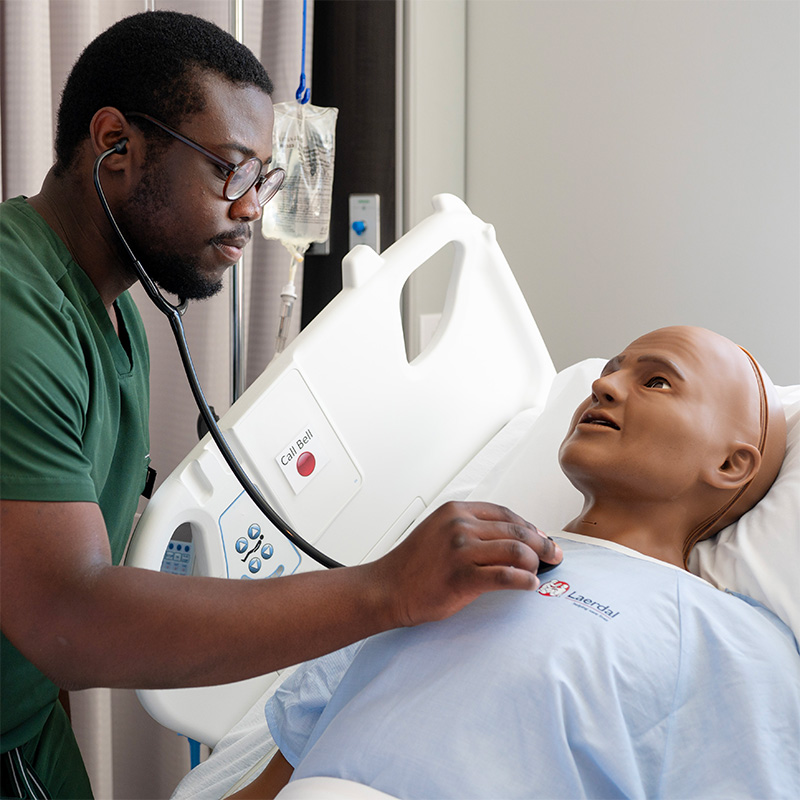
First-year students spend time in laboratory settings learning and applying introductory communication and health assessment techniques necessary to begin the process of developing clinical judgment as a nurse.
Courses for students entering program Fall 2026 and beyond
- Nursing 1040A - Foundational Concepts of Professional Nursing Practice
- Nursing 1050A - Academic and Professional Strategies for Success in Nursing
- Nursing 1330A - Human Anatomy for Nursing Students
- Physiology 1020 - Human Physiology
- Nursing 1080A - Holistic Health Assessment I: Communication for Health Assessment
- Nursing 1120B - Community Models of Care
- Nursing 1190B - Enacting Social Justice & Equity in Nursing Practice
- Nursing 1140B - Introduction to Health Informatics within Nursing
- Physiology 1020 - Human Physiology (continued from Term 1)
- Nursing 1180B - Holistic Health Assessment II: Systematic Health Assessment
Students build upon their foundational first-year knowledge by gaining deeper insights into nursing practice through both classroom and experiential learning. In Term 1, students explore the complexities of aging in an older adult theory course and apply this knowledge in a long-term care placement. Clinical judgment is further developed through the examination of health challenges and the exploration of barriers and facilitators to optimal health in individuals across the lifespan.
Term 2, learning is enriched through clinical simulation that mirrors hospital settings, as well as laboratory experiences focused on more advanced skills, including aseptic technique and medication administration. Throughout the year, students are also introduced to research methodologies, and evidence-informed nursing practice, supporting their ongoing professional development.
Courses for students entering program Fall 2026 and beyond
- Nursing 2250A - Understanding and Using Research
- Nursing 2270A - Nursing Care for Older Adults
- Nursing 2290A - Epistemic Justice
- Nursing 2440A - Pathophysiology
- N2271A - Laboratory & Clinical: Engagement in Care
- N2630B - Nursing Care for Clients with Acute & Chronic Health Challenges
- Nursing 3340B - Understanding and Using Research: Analyzing Data
- Pharmacology 2060B - Introduction to Pharmacology & Therapeutics
- Elective (0.5 credit)
- Nursing 2231B - Laboratory & Simulation: Supportive Care for Clients with Non-Emergent Health Issues
A deeper focus on acute and chronic healthcare considerations, as well as mental health concepts is experienced by students in theory and the simulation environment. Expansion and development of higher levels of nursing knowledge within the profession are explored in courses related to global health context and data analysis. Knowledge and clinical judgment will be further refined during professional practice placements in acute care settings such as long-term care, medicine, surgery, and orthopedics in the first term, and more specialized units with higher patient complexity in the second term.
All professional practice placements will be located within the Southwest geographic area.
Courses for students entering program Fall 2026 and beyond
- Nursing 3456A - Indigenous Health: The Influence of Policy & Practices
- Nursing 3500A - Nursing & Family Health
- Nursing 3630A - Nursing Care for Clients with Acute & Chronic Health Challenges II
- Elective (0.5 credit)
- Nursing 3911A - Clinical Application: Engaging in Critical Thinking
- Nursing 3440 - Oncology
- Nursing 3820B - Microbiology & Immunology for Nursing Students
- Nursing 3920B - Nursing Care of Clients with Mental Health & Illness Challenges
- Nursing 4320B - Professional Ethical & Legal Obligations: A Critical Appraisal
- Nursing 3921B - Clinical Application: Managing Client Care
In the accelerated fourth year, students begin their first term in the summer and finish term two in the fall instead of the winter.
Students begin to consolidate their knowledge in classes that explore ethical theories and the legal aspects of nurses’ role, nursing regulation and practice standards, social justice, leadership and advocacy. Students examine the role of the nurse in shaping and influencing future directions in health and health care related to economics, technology innovation, power, and policy.
Advanced clinical concepts are explored with a deeper understanding and application of clinical judgment in theoretical courses, as well as in professional practice placements. Students finish their fourth year ready to apply knowledge in their integrative practicum experiences a nurse preceptor preparing them to enter the profession as a novice registered nurse.
All professional practice placements will be located within the Southwest geographic area.
Courses for students entering program Fall 2026 and beyond
- Nursing 3310A - Health in a Global Context
- Nursing 4401W - Integration of Advanced & Complex Concepts for Nursing Practice
- Nursing 4440A - Nurses as Leaders in System Transformation
- Elective (0.5 credit)
- Nursing 4410A - Clinical Application: Applying Advanced Care Concepts
- Nursing 4461W/X - Integrative Practicum
Ready to Choose Western Nursing?