
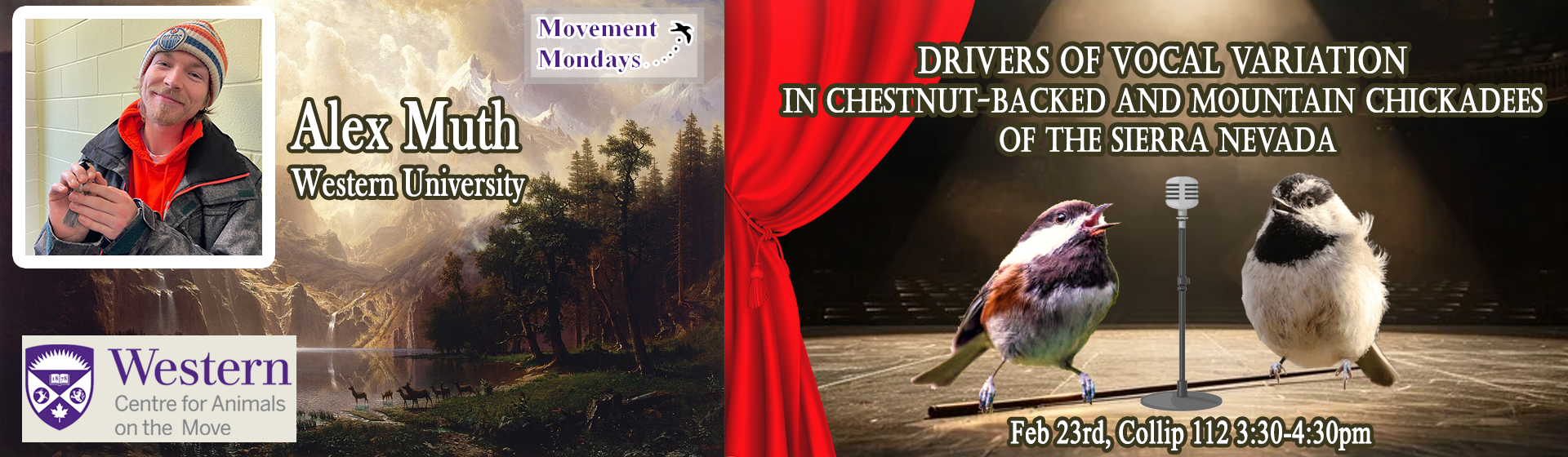
Summary: Vocal signals vary within and between species and often reflect functional differences in how individuals interact. Thus, understanding how vocal variation develops and is maintained is a key question in behavioral ecology. Multiple analytical methods, including spectrotemporal analyses and information-theoretic approaches, are needed to evaluate these hypotheses because they make predictions about different aspects of vocal signals. I applied both approaches to test these hypotheses in Chestnut-backed (CBCH) and Mountain Chickadees (MOCH) across sympatric and allopatric populations in the Sierra Nevada. Recent range expansion of CBCH into habitat historically occupied by MOCH in the Sierra Nevada has created new areas of sympatry, providing an opportunity to investigate how interspecific interactions shape vocal variation. Chick-a-dee calls consist of independent note types that follow syntactic note-ordering rules (e.g., A > B > C > D) and serve different functions. I predicted that spectrotemporal analyses would reveal vocal divergence in sympatry driven by character displacement, whereas information-theoretic analyses would reveal greater syntactic complexity in sympatry associated with increased social complexity. Preliminary data suggest that spectrotemporal characteristics of A notes diverge in areas of sympatry, while D notes display a mixed pattern of divergence and convergence. Additionally, syntax combinations vary between allopatric and sympatric regions. This research sheds light on the evolution of vocal variation and highlights the potential of chickadee vocalizations as indicators for monitoring ecosystem health.