Fall Talks 2026
2026-27 Colloquium Series
The Politics of Plato's Charmides: Socratic Self-Knowledge for You and Me
Speaker: Cecilia Li
Huron University College
Friday, November 6, 2026
5:00 p.m.
Dante Lenardon Hall (DL) 112, King's University College
 Photo courtesy of Cecilia Li
Bio: Cecilia Z. Li is an Assistant Professor of Philosophy at Huron University at Western University and a current Fellow at Harvard University's Center for Hellenic Studies. She specializes in ancient Greek philosophy, especially Plato's political philosophy. Her published work has explored justice and the expertise of ruling in Plato's Republic. At present, she is working on Plato's Gorgias and Charmides.
.
Abstract: The present study aims to highlight the dominant presence of the political element of the Charmides—an element that has been recognized but not, as I will argue, fully appreciated as central to the work’s philosophical goals. It argues that this enigmatic work can be fruitfully read as Plato’s serious and positive attempt work out a science (epistēmē) of Socratic self-knowledge so that we can flourish collectively as a political community, and in turn personally.
The central question posed by the dialogue is this: How is it possible to translate Socrates’ unique ability to examine what one knows and does not know become a branch of learning or a system of understanding (to mathēma) that can be learned, taught, and ultimately used to form the basis of a well-governed city? In other words, how can self-knowledge become something communal, not just for Socrates, but for you and me?
This reading allows us to understand the most enigmatic aspects of the dialogue and appreciate Plato (already in the “early,” “Socratic” dialogues) as an ambitious, highly original, and politically minded philosopher.
Knowledge of Language: Perspectives from Sign and Gesture Studies
Speaker: Endre Begby
Simon Fraser University
Friday, November 27, 2026
3:30–5:00 p.m.
STVH 1145
Photo courtesy of Endre Begby
Bio: Endre Begby is Professor of Philosophy at Simon Fraser University. His work spans across epistemology, philosophy of language, cognitive science, and political philosophy. Among his publications are articles in venues like Journal of Philosophy, Mind & Language, Philosophy and Phenomenological Research, and Philosophical Studies, as well as the monograph Prejudice: A Study in Non-Ideal Epistemology (Oxford University Press, 2021).
Abstract: Recent and emerging discoveries in Sign and Gesture studies put serious pressure on the widespread idea that we can model a subject’s knowledge of a language in terms of their knowledge of a well-defined set of rules governing, among other things, the grammar, semantics, and phonology of that language. First, I point out that all extant Sign languages are historically recent creations, which have emerged spontaneously (though gradually) from patterns of presumptively non-linguistic gestural communication among Deaf people. I argue that there is no unique point in their history at which these gestural systems would have transitioned to become “languages proper” (even as they are, indisputably, languages by now). Second, I point out that speech, no less than Sign, continues to functionally incorporate non-categorical “gestural” complements in both semantic and grammatical roles, pointing toward a conception of language – in any form – as a “multimodal” phenomenon.
Métis Nationhood, Citizenship, and Recognition
Speaker: Kurtis Boyer
University of Saskatchewan
Wednesday, September 30, 2026
3:30–5:00 p.m.
STVH 1145
For the Zoom link, please contact fhazrati@uwo.ca
 Photo courtesy of Kurtis Boyer
Bio: Kurtis Boyer is a citizen of Métis Nation–Saskatchewan and an Assistant Professor at the Johnson Shoyama Graduate School of Public Policy, University of Saskatchewan, where he holds the Research Chair in Métis Governance and Policy. He has advised Métis governments on constitutional reform and self-government and has testified before the Standing Senate Committee on Indigenous Peoples.
He is also a Fellow on Leadership and Innovation in Indigenous Governance at the Institute for Research on Public Policy (IRPP) and received the 2025 Lieutenant Governor’s Post-Secondary Teaching Award for Indigenous Teaching Excellence.
Philosophical Briefing Series
The Cognitive and Representational Roles of Intentionality
Speaker: Angela Mendelovici
Western University
Friday, November 20, 2026
12:30–1:30 p.m.
STVH 1145
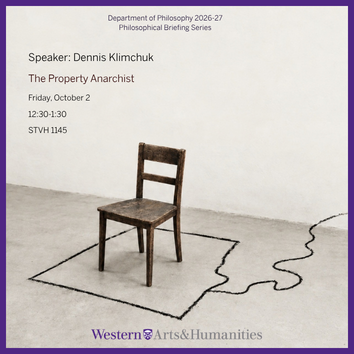
The Property Anarchist
Speaker: Dennis Klimchuk
Western University
Friday, October 2, 2026
12:30–1:30 p.m.
STVH 1145
For the Zoom link, please contact fhazrati@uwo.ca
Minorities and Philosophy Colloquium Series
Transgender in the Time of Trump
Speaker: Talia Mae Bettcher
Friday, November 13, 2026
3:30–5 p.m.
Location: Weldon library, Scholars Lab
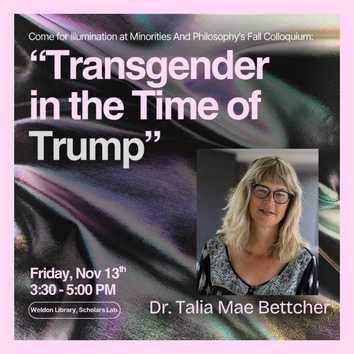
Bio: Dr. Talia Mae Bettcher is the Eddie Goldenberg Research Chair in Gender-Based Violence Prevention and Trans Community Resilience, and a recent addition to the Faculty of Arts’ new School of Social, Political and Historical Research at the University of Waterloo. Bettcher is internationally recognized as a foundational figure in trans philosophy, helping shape a field that was once represented by only a handful of scholars.
.
Abstract: In this talk, Talia discusses the gender critical philosophy underlying the Trump Administration’s attack on trans people. Specifically, she looks at the metaphysical picture underlying the view that women are adult, female human beings, as well as the political arguments for excluding trans women from spaces reserved for females. She argues that both the metaphysical picture and the political arguments are deeply flawed.


 Watch us on YouTube


